
 Private Harry DITCHFIELD

|
Regiment/Service:
|
Sherwood Foresters [Notts and Derby Regiment]
|
|
Unit:
|
6th Battalion, ‘B’ Company
|
|
Service Number:
|
2706 (Formerly: 3706)
|
|
Date of Death:
|
10 May 1915 (CWGC) – Died of wounds
(SDGW & MIC give date as 9 May)
|
|
Age:
|
23
|
|
Cemetery:
|
|
|
Grave Reference:
|
II. B. 1.
|
 Personal: Harry was born at 43 Grecian Street, Bolton, in August/September 1891 (baptised St Mark’s Church, Bolton, 4th October). He was the son of Thomas (Coal Hewer) and Ellen (née Wrigley) Ditchfield.
He had four older siblings, Josiah, Elizabeth, Mary Ann and Annie, and three younger, Lilian, Marion and Ellen. In 1901 (Census RG 13/3624) the family were living at the same address. Two other children had died in infancy.
Ten years later (1911 Census RG 14/23412) the family were at the same address and Harry was employed as a “Side Piecer Mule Spinning“. 
Two months after the Census, on 18th May 1911, Harry’s father, Thomas, died, aged 55/6.
In the December quarter 1912 Harry married Bertha Heywood, a “Housemaid“, working for the Cookson family of Longford Lodge, The Park, Buxton. (1911 Census RG 14/21236) It seems likely that this was when Harry moved to Buxton from Bolton.
They had two children Mary (born 13th November 1913) and William (born in the December quarter 1914, but unfortunately died at a few days old). The family lived at 29 Nunsfield Road, Fairfield, Buxton.
When he enlisted Harry gave his occupation as “Labourer“. He was 5 ft. 9½ ins. (1.77 m) tall and weighed 11 st. 8 lbs. (73.5 kgs.). When ‘The Buxton Advertiser’ reported his death in its edition of the 22nd May 1915 the family home was shown as “137 Riversdale” Buxton. It also reported that Harry had: “… paid his last visit home in February and shortly after left for France.”
The ‘Register of Soldiers’ Effects’ show that in January 1916 Harry’s widow, Bertha, had £1 11s 10d [£1.59] returned to her. In November 1919 she also received War Gratuity of £3. (This total of £4 11s 10d has an equivalent value of about £225 today – 2020.)
With effect from 29th November 1915 Bertha was awarded a Pension of 15s (£0.75 – about £60 today) for herself and her daughter, Mary. This rose to 18s. 9d. (£0.93 – about £75 today) on 4th April 1917.
On 29th April 1918 Bertha remarried Foster W. Sharp, in Buxton. She received the “Marriage Gratuity“, equivalent to one years’s Pension. Her pension ceased and the child’s portion remained payable to her as Mary’s guardian.
Harry’s mother, Ellen, died on 29th July 1953, in Warrington, Lancashire. His widow, Bertha, was widowed again in the June quarter 1928 when Foster died. She remained in Buxton until her death, aged 95, in May 1985.

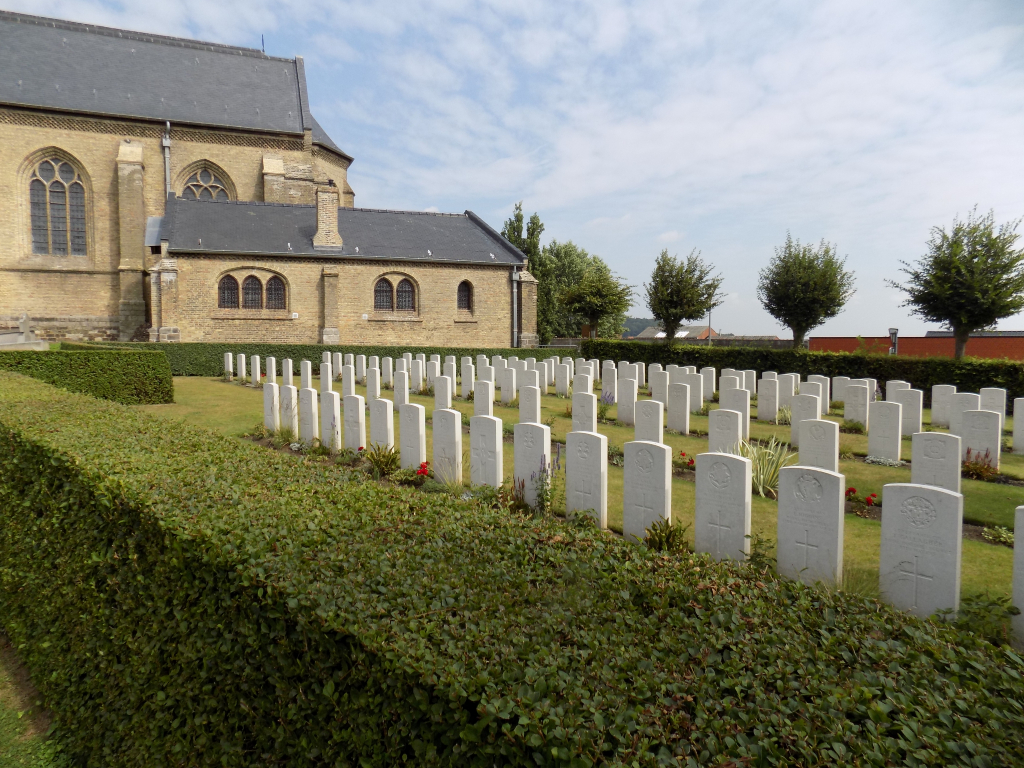 Harry’s Grave and CWGC Graves in Loker Churchyard, Belgium
Military Service: Harry enlisted into the 6th Battalion, The Sherwood Foresters, at Buxton on the 13th October 1914, for “The Duration of The War“. Being the local Battalion Harry more than likely joined “C” Company, based at The Armoury, Rock Terrace, Buxton. The Battalion had been formed in Chesterfield at the outbreak of War, part of Notts. & Derby Brigade in the North Midland Division. On mobilisation it moved to Harpenden and went on in November 1914 to Braintree.
King George V inspected the Division on the 19th February 1915 before, soon after midnight on the 24th February, the Battalion marched to Braintree Station having been posted to France, leaving Southampton on the 25th February 1915, landing at Le Havre the following day. The North Midland was the first Territorial Force Division to arrive complete in a theatre of war. The first months were spent in the Ypres salient.
On the 1st April 1915 the Battalion (as part of The Division) received orders to march to Locre in Belgium to relieve the 28th Division in the trenches around Kemmell. The 6th Battalion alternate trench duty on a four day rotation with the 7th Battalion. They stayed in this area until well into June.
“When the Battalion first went into the line there were no communication trenches and all journeys to the front had to be made by night, and to the 6th was allotted a piece of digging of which they were justly proud. This was the digging of the long trench which was named “Via Gellia” after the well known Derbyshire road of that name. [Trench pictured below left, postcard of Via Gellia c. 1920s]

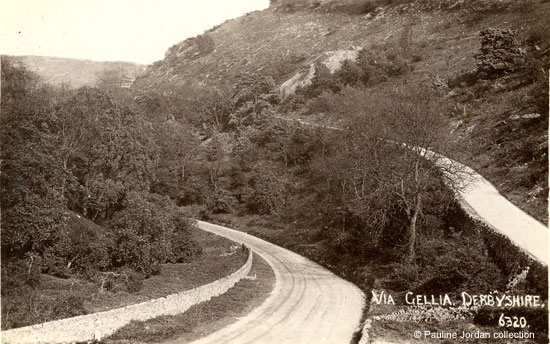
The digging was accomplished in two nights and as Via Gellia it remained a memorial to the Battalion until two years afterwards when after the Battle of Messines it was dismantled. Fortunately Colonel Goodman, who happened to be with his Brigade not far away, secured the name board of the trench and it is now in the Regimental Museum collection.” (Battalion History, page 34)
On the 3rd May 1915 Harry received a bullet to the head and died of wounds received in the field six days later. (His Service papers confirm he died on the 9th not the 10th.) He had survived in France just 71 days and a total of 181 days with the Colours. He was buried in the nearby Cemetery at Locre. His wounds probably came from sniper action in the front line trenches.
Private George Bradshaw kept a diary during his Service and gave this account of the circumstance of Harry being wounded: “Things went on as usual until afternoon when word came down that Private Ditchfield of B Company had been seriously wounded, could anybody volunteer to fetch him. Four of us went up by the communications trench which our brigade had made. [i.e. ‘Via Gellia’]
We had a job to get him out of the trenches as they were very narrow, but after a hard struggle we got him out and down to the dressing station. After he had been dressed we set off to meet the motor ambulance vehicle which cannot come into Kemmel during the day or the Germans would see them and then we should get shelled out. We met the ambulance over the hill. We carried him in all from two to three miles. By bringing him out in the daylight we either saved his life or prolonged it. We were wet through with sweat.”

No other men of the 1/6th Battalion died on the same day as Harry, however, on the 5th May the 6th Battalion had significant casualties. The History (page 38) records that: “In rear of the chain of front line trenches were several small blockhouses, and one of them, known as S.4.A. was on this date garrisoned by Lieut. V.O. Robinson and thirteen other ranks of “A” Company, and also by a machine-gun detachment composed of one Sergeant and four men, with a Battalion signaller.
During the course of the afternoon a “Jack Johnson” fired from the German lines fell full upon the post and blew it completely to pieces, the garrison being almost wholly wiped out. Of the party occupying the post, eight were killed and eight wounded, while three, including the officer, were buried under the debris, and two others were found to have been so completely “knocked out” and dazed that one of the men wandered aimlessly off towards the German lines where he was almost at once shot down and killed.“
N.B. a ‘Jack Johnson’ was a High Explosive howitzer shell which burst in a cloud of black smoke; name taken from a famous Black American boxer of the period.]
 The CWGC shows the 8 men (as recorded above) of the 1/6th killed in action on the 5th May, are all buried in Kemmel Chateau Military Cemetery. Locre was in Allied hands during the greater part of the war and field ambulances were stationed in the Convent of St. Antoine (right – before the War).
Harry, wounded in the action of the 5th and died of his wounds on the 9th May 1915 at the “1st North Midland Field Ambulance“, and was buried in the village churchyard close to the Convent where he died.

… the 1/6th Battalion’s stay in the Kemmel sector for 3 months until the 20th June 1915.
The Battalion Chaplain, Rev. J. P. Hales, D.S.O., initially wrote to Harry’s wife after he had been wounded. ‘The Buxton Advertiser’ of the 22nd May 1915 reprinted the letter as follows: “Dear Mrs Ditchfield, – I am writing for your husband, who is not able to write himself. I regret to say that he has been wounded and is very ill. The bullet caused a bad head-wound, but he is now conscious, and seems much relieved that I am writing to you for him. They have done everything that they possibly can do to make him comfortable, and I can assure you that he is well cared for.
He has got pneumonia too, which causes us much anxiety. I will write to you again. In the meantime everything is being done for him that can be. I pray for him constantly. He is so brave and patient. Having a wife and children far away myself, I can so thoroughly sympathise with you. God bless, comfort and strengthen you.“
The same edition of the ‘Advertiser‘, however, also reprinted a letter from Battalion C.O. Colonel Godfrey Davenport Goodman, written on the 11th May, after Harry’s death, which read: “It is with great regret that I have to inform you of the death in Hospital of your husband. He was wounded in the head, and at first we had hopes of his recovery, but it was not to be. I believe he did not suffer much, and he was, at any rate, very brave and cheerful.
He was buried with other British soldiers in a churchyard not far from the trenches. It will be some consolation to you that he died for his Country. With deep sympathy for yourself and your child.”
Letters of sympathy had also been received by Harry’s wife, Bertha, from Pt. (2661) Sam Read and Sgt. Major E. Brown.
[N.B. Brigadier-General Sir Godfrey Davenport Goodman, KCB, CMG, DSO, VD, TD, DL, (right) came from Chinley, Derbyshire, and was made a Freeman of High Peak and Buxton on the 18th January 1939.]
|
Sources:
· “The Buxton Advertiser” – 22nd May 1915
· I am grateful to Frederik Sohier for the photograph of Harry’s grave.
· “Men of the High Peak: A History of the 1/6th Battalion the Sherwood Foresters 1914-18” W. D. Jamieson (Author), Clifford Houswey (Editor) [ISBN-10: 0952964864] page 38
|
||
